
We see it again and again, world leaders thinking, for some obscure reason, that bombs can make peace. Well, they don’t!
Did Putin get what he wanted when he launched his “quick invasion” of Ukraine? No! Instead the war is still dragging on, two and a half years later. Do Putin really think that he’s going to enter the history books as the leader who managed to restore the Russian empire? No, he’s going to to be listed as a man abusing his power, a leader crushing down all opposition among his fellow countrymen and -women, one who ignore human rights and who prosecute LGBTQIA+ people and whomever speaks against him. A leader that waged war on a neighbouring country without provocation.
In addition, Putin is every so often threatening to use nuclear weapons. What would happen if he do? It will only escalate the conflict further, and a peace treaty will no longer be possible. The retaliations against Russia would be severe. And again, he will certainly not appear in the history books as a great leader, but the one crazy man that pressed the red button.
Do the Israeli government lead by prime minister Nethanyahu create peace with their invasion of Gaza? And more resent their invasion and bombing of South Lebanon? Do Nethanyahu and his cabinet think that by killing tens of thousands of civilians in Gaza and Lebanon, in their hunt for Hamas, that they will obtain any kind of peace and security for the Israeli people any time soon? NO! All they do is escalating the conflict.
I strongly condemn the Hamas attack on Israel October 7, 2023, their killings and taking of hostages. I also strongly condemn the continuous attack on Gaza by the Israelis.
The only thing they are going to achieve by this war on the Palestinians, is creating more hate, more Palestinians turning against them, willing to sacrifice themselves for a free Palestine.
The Israelis continue to bomb hospitals and schools where people has taken up refuge, because their homes are destroyed, the refuge camps are not safe, in their hunt for Hamas. So far more than 41 500 Palestinians have died, the great majority civilians. In comparison, the Israeli has lost 1 706 people. I don’t like to compare numbers like this, but it shows the efficiency of the Israeli army compared to their opponent.
Now the situation is getting even more dangerous, as Iran is about to be involved as well. We are on the verge of a full scale war in the Middle-East, a war that is only going to create more hatred and conflict, and no peace.
The Israeli government, led by Nethanyahu, has given the green light for more illegal settlements. They are still pushing on Palestinian land, imposing restrictions on their movements, blocking supplies. And this was before the war started. What do they think they will accomplish? That the Palestinians would surrender and say, OK, you win, we move? As long as Israeli politics are formed and carried out in a way that threatens the existence of the Palestinian state, Israel will never be safe either. How hard is that to understand?
With all this said about the Israeli response to the October 7 attacks by Hamas, I don’t understand what the latter thought they would obtain either, except for severe retaliations by the Israelis. Did they think that Israel would “surrender” after the attack? What on earth were they thinking? In one way, we might say that it was Hamas that brought all the destructions on Gaza, on it’s own people. They knew for sure that Israel would react. How could they not? If my neighbour starts shooting at me, am I not forced to protect myself? How come Hamas launched this attack, fully aware of the possible retaliations? Hamas also knew that the population of Gaza has literally nowhere to go, nowhere where it’s safe. It is pure cowardice to use women and children as shields. The Palestinians suffered enough as it was, for Hamas to bring this war on them by their actions. Again, acts of war don’t make peace.
Unfortunately, as long as there are people on either side that has no interest in a peaceful solution, the situation will never be solved. We all thought peace between Palestine and Israel would become a reality after the signing of the Oslo Agreement in 1993 and the Oslo Agreement II in 1995. It was supposed to be a first step towards a peaceful co-existence between Palestine and Israel. There were people on both sides that were not happy with the outlines in these agreements, but negotiations were supposed to carry on. When the Likud party (Israel) won the elections in 1996, the agreement was put aside, and negotiations halted.
Since then the situation has become more severe, until this last devastating escalation. Peace has never been further away. I don’t know how the situation can be solved, neither in the Middle-East or in Ukraine, but one thing is for sure, bombs don’t make peace.
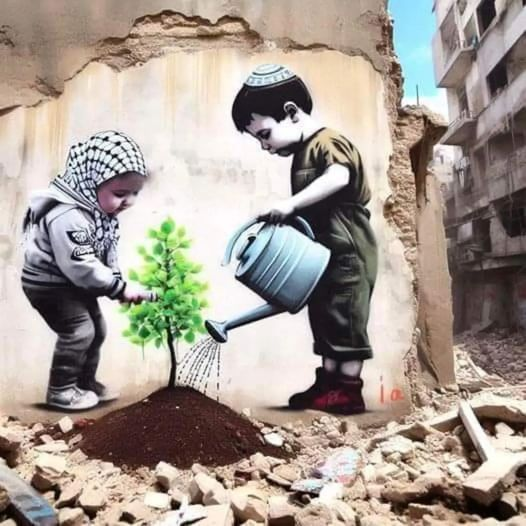
Image by Banksy
 The Phoenix